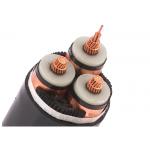
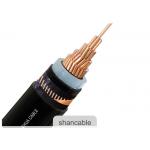
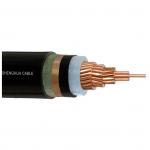
Low Conductor Resistance Pure Copper XLPE Insulated Power Cable is made for buyers who count energy losses in kilowatt-hours and
money. This low conductor resistance cable uses 99.99 percent pure
annealed copper conductors that meet IEC 60228 Class 2, so
resistance per kilometre stays low and I2R losses shrink. For long
feeders and continuous industrial loads, a high conductivity power
cable with genuinely low conductor resistance pays for itself
through reduced heat and lower electricity waste.
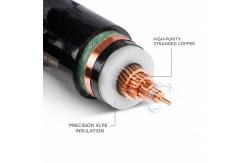
The pure copper xlpe cable design compactly strands the copper to
increase the fill factor, which brings conductor resistance even
closer to the theoretical minimum. Combined with a cross-linked
polyethylene insulation rated for 90 C continuous duty, this low
conductor resistance cable carries more current in the same
cross-section, letting designers reduce copper usage without
sacrificing performance. Every reel of this pure copper xlpe cable
is routine tested for DC resistance and voltage withstand, so the
high conductivity power cable you receive matches the datasheet
value.
Technical Specifications
| Parameter | Specification |
|---|
| Product Name | Low Conductor Resistance Pure Copper XLPE Insulated Power Cable |
| Rated Voltage | 0.6/1 kV |
| Conductor | 99.99% pure annealed copper, Class 2 |
| Insulation | Cross-linked polyethylene (XLPE) |
| Outer Sheath | PVC |
| DC Resistance | Within IEC 60228 Class 2 limits |
| Continuous Temperature | 90 C |
| Cores | 1 to 5 cores |
Key Advantages
- Low conductor resistance cuts I2R energy losses.
- Pure copper xlpe cable conductor meets IEC 60228 Class 2.
- High conductivity power cable allows smaller cross-sections.
- Compacted stranding improves fill factor and lowers resistance.
- Routine DC resistance testing proves every reel.
Applications
- Long feeders in factories and industrial plants.
- Substation and transformer station power supply.
- Continuous load circuits where losses matter.
- Commercial buildings and data centre power feeds.
Frequently Asked Questions
Q: How low is the conductor resistance of this pure copper xlpe
cable?
A: It meets or beats the IEC 60228 Class 2 limit, so this low
conductor resistance cable keeps losses low across the full
cross-section range.
Q: Why prefer a high conductivity power cable over aluminium?
A: Copper lowers resistance and voltage drop, making this low
conductor resistance cable ideal for high-current, long-run
feeders.
Q: Is this pure copper xlpe cable tested before shipment?
A: Yes. Every reel of this low conductor resistance cable undergoes
DC resistance and high voltage tests.
Manufacturing and Quality Assurance
Shenghua draws and anneals its own copper so that the low conductor
resistance of every length can be certified against IEC 60228. Each
pure copper xlpe cable reel is measured for DC resistance and
voltage withstand, and the results are recorded on the drum
certificate, so the high conductivity power cable you receive
matches the datasheet. Because copper purity drives loss, we keep
the low conductor resistance cable at or below the Class 2 limit,
and the high conductivity power cable is available with compacted
stranding to lift the fill factor further. Designers who compare a
pure copper xlpe cable against aluminium for a long feeder will see
the low conductor resistance cable reduce voltage drop and heat,
and our engineers will share the resistance table for any size.
Why Buyers Choose This Cable
- Low conductor resistance certified to IEC 60228.
- Pure copper xlpe cable with 99.99 percent annealed copper.
- High conductivity power cable lowers voltage drop.
- DC resistance recorded on every drum certificate.
Additional Questions
Q: Can you supply the DC resistance table for this pure copper xlpe
cable?
A: Yes, we share IEC 60228 values, and every low conductor
resistance cable ships with measured data.
Q: Why is a high conductivity power cable better for long feeders?
A: Lower resistance means less voltage drop and heat, so the low
conductor resistance cable saves energy over the run.